Teachers should teach, not be police
Visit NBCNews.com for breaking news, world news, and news about the economy
The Sandy Hook massacre inside an elementary school has shocked us all. While we want everyone to be safe, we expect our youngest to be so inside their own school.
My children attend Clayton School District, one of the wealthier districts in St. Louis County. Like many local districts, it already has police officers at the high school and middle school. On Monday when I went to pick up my youngest, I saw a different police officer at the elementary school. I was a bit taken aback but assumed he was there to help parents feel more secure in the first few days after the Connecticut shooting. I am hopeful that the district does not spend money to keep police officers or even armed security at the elementary schools long-term as the expense would not be justified.
Other school districts such as Kirkwood and Florissant are considering police officers at elementary schools in their school safety reviews. I believe, however, that time and calm parents will help them spend limited resources wisely.
I do agree that schools should review safety procedures as they have after each school shooting and periodically otherwise. Safety experts learn from each experience. For example, whoever turned on the intercom at Sandy Hook, whether intentionally or not, alerted the teachers to the severity of the problem. These types of details are important to safety plans.
St. Louis County Police Chief Tim Fitch said that each officer costs a district about $50,000 for a nine month contract. (Really a 10-month contract) In order to afford that, the district would need to lay off a teacher at each elementary school. That is not a trade-off I am willing to make.
As an alternative to paying for police officers at the schools, some politicians such as Texas governor, Rick Perry, have advocated arming teachers as a way to make schools safer. On Sunday, Chief Fitch brought the gun control debate squarely to the St. Louis school districts.
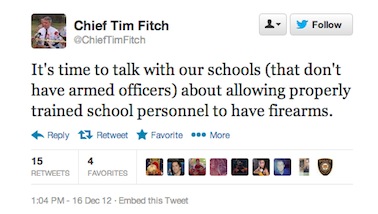
The St. Louis Post-Dispatch followed up with a front-page story discussing Fitch's suggestion and other security possibilities. The local districts did not react with enthusiasm.
Fred Crawford, chief of security for the Parkway School District, said he would favor more police in schools over gun training for school officers.
The districts are right to hesitate. Teachers with guns in the classroom, even in a locked drawer, would bring a whole new set of problems to schools. That gun is more likely to be found and used against the teacher or other students, the teacher is not going to be as experienced as an active police officer, that gun is unlikely to be useful against a prepared killer like Adam Lanza with a bulletproof vest on, the teacher would be spending time helping students to safety, police might mistake teacher for intruder etc. I would not send my kids to school with a teacher carrying a gun or with a gun in a locked drawer in the classroom. If the gun is locked up in the office, I would still feel uncomfortable. Who would have access? Have the parents been notified who has access? Their training? The date and continuation of their training?
In addition, districts hire teachers to teach, not to act as security.
"I'm a former teacher and my daughter teaches currently. I want our teachers to be trained so that we can address the problems of literacy, so that we can improve our education system. Let the public safety people handle these other issues." --Rep. John Larson (D) Conn. on NOW with Alex Dec. 17, 2012
Districts should re-evaluate their safety plans and assess whether to add more security, depending on the local needs, not as an emotional reaction to a horrific situation. They should not, however, ask teachers to become that security force.
Let them eat...zucchini?
| The Daily Show With Jon Stewart | Mon - Thurs 11p / 10c | |||
| Little Crop of Horrors | ||||
| ||||
With the attention paid to our nation’s pathetic eating habits and the Obama’s organic garden, now seems to be a good time for the St. Louis area school districts to vastly improve their school lunches. Maplewood Richmond-Heights is in front of the “Race to the Top”, in terms of lunches anyway, as it implements its Healthy Eating with Local Produce grant in conjunction with St. Louis University.
"The kitchen staff has reshaped menus and already ordered their produce from the farmers in the Missouri Farmers' Union," superintendent Henke said. "Some of our high school students will have summer jobs helping process the foods this summer." (Gardening Teaches, Suburban Journals, 2 June 09)
This is in sharp contrast to most of the area school districts. Yes, they may offer some fresh fruit and vegetables at a food bar, a recent and welcome addition, but the overall menu is still weak.
Here’s a typical week’s menu. This one is for elementary schools from one week in May from Kirkwood school district, which uses Chartwells.

Here’s a menu from Chef Ann Cooper’s elementary menu (pdf). A daily menu might be chicken or veggie quesadilla, rice and beans, salad bar, 1% milk, fresh fruit.
Elem_calendar_sept
Like Maplewood, Kirkwood, U City, Ferguson-Florissant, St. Charles and Clayton have farmer’s markets within their borders. Let’s step up to the plate, schools.
Longer school year?
Arne Duncan is looking at longer school days or years to help improve our country’s education and to help our students compete in a global economy in which many countries such as India and China go 20 to 30 days more a year. I’m sure students won’t like this idea, I doubt teachers will, and I’m not confident parents will either. However, I think that we should consider a longer school year.
I was at a committee meeting last night at my children’s elementary school in which the principal was telling us about a decision made to change the allocation of minutes. Every addition of time is a trade-off. Adding more minutes to the school day isn’t necessarily the best decision since young children need some time to play, but a longer year would ease the minute turf war and reduce summer retention problems.
The parents at the meeting kept asking about when the teachers were able to meet together district-wide by grade level. Teaching has traditionally been a solitary profession but is increasingly team-oriented as planning is done in groups. To facilitate this districts need to provide time for teachers to meet in various teams. Some districts do better at this than others, but all of them need to do more.
School year length ranges from 190 days for Farmington to 167 for Wheatland in Hickory County and Appleton City in St. Clair County. The St. Louis city and county districts have a narrower range from 174 to 178 with Ritenour as an outlier at 182 (good for it!). (Numbers from DESE)
The length of school day in St. Louis county and city ranged from 6.6 in Kirkwood (with quite a few districts at 6.5) to Jennings at 6.0. Jennings has a shorter day and one of the shorter years, but other districts mixed the two. For example, Clayton has one of the longer years but shorter days to allow for after school teacher meetings. Some of the districts such as University City and Bayless had a longer day at 6.5 hours but relatively shorter year at 175 days. Kirkwood, Ladue and Ritenour have students attending the most hours. Jennings and Hazelwood are at the bottom.
The number of hours taught ranged in the state from a high of 1209.5 (Centerville in Reynolds County) to 1014.5 (Calhoun in Henry County).
I predict that the we don’t have a significant change in the next couple of years but a quickening of the incremental pace we’ve been having in the increase of time as pressures mount on districts to improve. The state will need to come in and establish minimums for the rural areas that don’t face the same competition.
What do teachers make anyway?
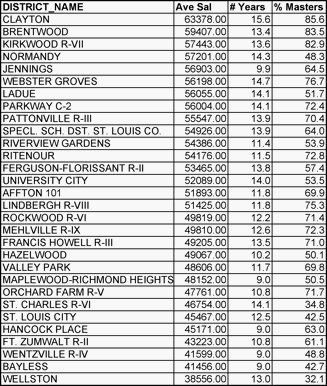
Source: DESE
I assumed that Clayton would be the top-paying district in the county, and I was correct. The average is high because the district prioritizes experience and advanced eduction. The average number of years teaching is 15.6; while Webster Groves, the next highest, is 14.7—almost a year less.
Clayton, Brentwood and Kirkwood all have over 80 percent of teachers with at least a master's degree. They are also the highest paying districts. This is no coincidence as I found a .76 correlation between average salary and percent with a master's. This is much higher than the still statistically significant .40 correlation between average salary and average number of years teaching.
At a future date I will compare the percent with a master's to quality of schools because in looking at it, that seems to be a pretty good indicator, with Ladue as a weird outlier. (What's up with Ladue only having 50 percent of its teachers with a master's? They're not young (14.1). This deserves further research.)