MAP student reports give parents LESS information
09/24/08 14:42 Categories: Assessment

Photo by flag75*
If giving parents more information is the national trend, Missouri is going in the wrong direction. This year’s MAP student report (pdf) given to parents provides less information than before (pdf). Previously, parents were given the number of points possible and the percent of points earned for each subsection, which were related to the standards. That way they could see their child’s strengths and weaknesses within a content area.
This year parents are given the total score, no subtest break-outs.
As a parent I like that my child is also given a TerraNova score as it is nationally normed. Most parents I know prefer normed scores rather than standards based scores because it provides them with a frame of reference. (I have yet to meet a parent that actually likes standard-based report cards since they appear pretty meaningless to us.) How hard is it to get into the advanced category? proficient?
Speaking of frame of reference, the other piece of information given, the Lexile score, is completely lacking that for most parents. What does it mean? Oh, we’re told to go look it up. In the past parents were provided some information on the score, but not this year. Now it’s just see the website and talk to your local librarian.
❝The score measures the reading skill level of your child, so you may choose books that will encourage reading progress at www.Lexle.com. Here you will find a list of titles withn your child’s Lexile range. Your local/school librarian can also help you find books within your child’s Lexile range.❞
I’m an informed parent, and I had to find a conversion chart.
Parents want information, but I’m afraid educrats are too used to seeing these results and don’t know how to provide them in a helpful manner and manage to both under and overestimate parents at the same time.
So while educators, policy wonks and social scientists debate the validity of various assessment measurement methods (which I’ll follow with interest), I would like the state to improve its communication to the parents. Perhaps it should start by having some parents help out.
Parents tracking their kids' attendance, grades online
09/17/08 14:53 Categories: Parents
Photo by Ian Fuller
When Sarah Brodsky of Show-Me Institute asked why St. Louis area weren’t being more innovative by implementing programs such as online grade and attendance monitoring by parents, I was surprised as I thought they were doing that. After checking most of the county school districts, I found that they were. (I couldn’t find it on Parkway’s website. Do they not have it or is it just not easily found on the website? They do have online lunch accounts, which I wish my kids’ district had, so I’m assuming they have chosen not to have attendance and grades monitoring.)
The St. Louis Public Schools did not have any online monitoring that I could find. For a district that struggles with attendance, I would think that allowing the parents to easily check on their kids’ attendance and tardies would be a high priority. “Johnny, you were tardy for biology again today. You’re grounded!”
Hospitals, school districts benefit from open data
09/09/08 17:28 Categories: Assessment

Driving home the other day I heard a discussion on NPR Talk of the Nation about putting hospital statistics online so people can compare them. I immediately thought that if one substituted the word schools for hospitals the discussion would be the same.
Challenges of comparing high-risk patients to low-risk patients. Check.
Hospitals not being eager to provide data. Check.
Benefits of openness and transparency. Check.
Need to put checks in to prevent hospitals from gaming the system. Check.
The show concluded by the experts agreeing that this is an important but still small first step in accountability, openness and transparency. The biggest benefit comes not from patients being able to compare hospitals but from hospitals sending staff to high-scoring ones to learn from them.
In that spirit, if I were a superintendent in the St. Louis metropolitan area, I would send someone to Fox to find out why they have the highest percentage of free and reduced lunch students in the St. Louis area scoring at proficient or advanced in both math and communications MAP scores.
I chose this picture because I liked it and Children’s is, unfortunately, the hospital I have used the most often as I have three children. The website focuses on acute care and doesn’t include pediatric hospitals like Children’s or Cardinal Glennon even though it has a section for children’s asthma.
District spending seems a bit random
09/08/08 15:08 Categories: Finances
A commenter to skoolboy’s post on the Chicago protest wondered if wealthier districts did a better job educating students eligible for free or reduced lunch. So I ran some St. Louis numbers. Nope.
There is no correlation between per pupil spending in a district and the percent of free or reduced lunch students who test proficient or advanced on the math MAP test. (-.24) There isn’t even a correlation between per pupil spending and the percentage of total students who test proficient or advanced on the math MAP test (-.04)
After looking at the numbers, however, I was surprised at the districts’ spending levels. Clayton having the highest spending is no surprise to anyone, but the number two district is Wellston, the district that has the lowest test scores in the county and that has lost its accreditation.
Does per pupil spending reflect a community’s wealth though? Not as much as we would expect. In fact, not at all. The correlation between per pupil spending and median household income is -.15 (This differs from skoolboy’s findings on Illinois and could from the state of Missouri, but I focused on the St. Louis metro area. I also didn’t use the exact same method he did.)
My next attempt to find a commonality was to draw a map. Bingo. I colored in the top third per pupil spending purple, mid third medium blue and bottom third yellow.
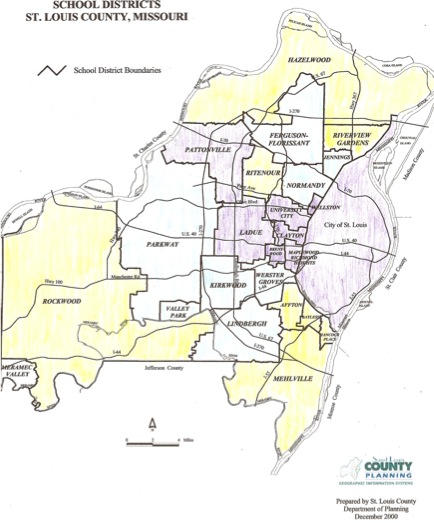
Since the city and middle corridor obviously spend more irrespective of community wealth, I hypothesize that the older buildings cost more to maintain. Obviously, teacher salaries could play a factor here too, but those are numbers to run another day.
I’m not arguing that since there’s no correlation, we should reduce funding for all the districts. However, we also can’t equate funding with equality as so many other factors come into play.
How long do we need to study about Missouri
09/03/08 13:32 Categories: History
While my natural inclination is for local control as much as is feasible, nationalizing standards has some appealing arguments. For example, fourth graders throughout Missouri aren’t studying world history, American history, civics or other typical social studies topic. Nope, they’re taking a year to learn all there is to know about—Missouri. The state of Missouri. I’ll grant you we have some interesting history in the state. I even understand how they can acquire necessary skills such as reading maps, comparing and contrasting geographical regions etc. But, really? A whole year on Missouri?
If you live in another state, don’t start feeling superior because the children in your state are also studying it for a year most likely. If you’re lucky, they will revisit it in a later grade (here’s looking at you South Carolina!).
I think a unit or even two on the state is sufficient. I would even spiral that back around in later grades as students get closer to voting age. Heck, by then they might even still live in the state by the time they’re 18, so learning the names of their governor, state reps and state senators isn’t asking too much of a high schooler.
If families never moved, you could make the case for studying their own state in such depth, but that is not reality. With mobility rates of 15-20 percent, we can hardly justify spending an entire year on a single state.
Some may make the case that kids start out learning about their family, their neighborhood, then their community, and work their way up to their state, country and finally the world. How boring is that! Besides, kids have an easier time understanding other countries than state or county divisions, so learning is not quite so linear as that.
I suggest choosing high-interest topics such as ancient Egypt, pre-Columbian Maya or medieval Europe to introduce historical methods and skills. You could certainly include some Missouri-related units such as Lewis & Clark. I would then emphasize the state history within context of U.S. history as kids develop a sense of time flow in later elementary. That would seem to make more sense.
I think lack of world knowledge is a bigger problem overall than lack of state knowledge, so I can’t see how reducing time spent studying the state will harm our country’s ability to compete in the global economy.