Districts Need Higher Math Expectations for All
Cross-posted to Clayton Richmond Heights Patch
School districts throughout Missouri are reevaluating their math programs because the state is planning on adopting the new Common Core standards. While some people may balk at the idea of nationalized standards, politicians need to put their petty power disputes aside and look at what is best for kids. Massachusetts said it would not join the coalition unless the standards were at least as rigorous as its own, driving the standards up rather than the more typical downward spiral we tend to expect. While the Missouri MAP tests are challenging, the standards were poorly written. Adopting the Common Core standards is a positive step.
Clayton School District's math curriculum committee has made some substantial recommendations in its cyclical review of the math program. Other districts will be looking at their math programs whether they are up for review or not because of the upcoming changes in standards.
Clayton recommended changes:
•eliminating the integrated math sequence at the high school
•requiring the majority of 8th graders to take a full algebra course in 8th grade instead of the “algebra light” course currently taught
•recommending new textbooks for the high school and middle school (elementary will be reviewed this coming year)
•beefing up content mastery and fluency at the elementary
•requiring Algebra I level knowledge for all elementary teachers, Algebra II level knowledge for middle school math teachers
While the board seemed pleased with the amount of work put into the 621-page document, the members were not completely satisfied. They wanted more.
“Will this document guide us to ensure our teachers and curriculum teach a variety of ways so all of our children can excel?" she [Susan Bradley-Buse] asked the committee. “I don’t see that in here.” (Travis Pringle, “Math Curriculum Update Draws Questions on Textbooks, Teaching Styles”Clayton-RH Patch 29 April 2011)
I want to see math educators broaden their view. Instead of focusing on test scores and teacher recommendations to select a few students into the honors sequence, they need to emphasize looking at practices that can help as many students as possible excel at a high level.
Districts often provide support structures for struggling and exceptional students, but what about making those available for a wider base? For example, Clayton currently offers extra support courses for students in regular math classes so that they can be successful. This can help many students avoid taking less-intensive courses but gives them the extra help needed. I think this is a wonderful concept that should be more broadly applied. Possibilities could include a summer class to help middle school students move from regular math to honors, tutoring sessions taught by college and high school students, support groups for math anxiety, etc.
Finland consistently ranks at or near the top on the international test PISA. All students take the same course together with struggling student provided extra help.
A tactic used in virtually every lesson is the provision of an additional teacher who helps those who struggle in a particular subject. But the pupils are all kept in the same classroom, regardless of their ability in that particular subject. (Tom Bridge, “Why do Finland’s Schools Get the Best Results?” BBC 7 Apr 2010)
U.S. students are not the same as those in Finland, but teachers here can learn from their strategies for helping all students.
Moving algebra to the 8th grade for the majority of students is a good first step, which I would like to see replicated across the metropolitan area, but I think we need to go further. Students should be encouraged, not discouraged to challenge themselves even if it takes some extra work.
I’m not advocating eliminating honors courses but emphasizing to students that practice and hard work is more important than innate ability in achieving at a high level in math. If districts start ability grouping at a young age, they have a responsibility to counter that unspoken message by providing creative and productive extra support all students could use to excel in math.
Making Geek Cool Hall of Shame

As a follow-up to my previous post Making Geek Cool Hall of Fame in which I laud people, TV shows or events that improve the coolness factor of geeks, I've started compiling a Hall of Shame list. I actually had a harder time with this one. Maybe it's my inherently nice nature, but I found it easier to rail against the culture as a whole rather than specific elements.
I'm sure, however, that you will not have that problem. I would love to hear additions to my list by comment, email or tweet!
1. Disney Channel—when making my Shame list, it ended up just being a list of Disney and Nickelodeon shows, so I decided just to name the two channels as numbers 1 and 2 on the list. Upper elementary kids are especially susceptible to the anti-geek message from television, so I think these two popular channels should be ashamed. Hannah, Wizards of Waverly Place, Suite LIfe on Deck: Can we just have an intelligent girl or boy in the lead role instead of the "geeky" sidekick or brother?
2. Nickelodeon—see comment above. I did put iCarly on the Fame list, so kuddos there, but it, too, has anti-geek elements.
3. Seventeen magazine and other teen magazines for girls
4. My husband—I hate to say it, and I'm sure he's not the only parent out there, but he has on occasion slipped into the the ‟You don't want to be a nerd so get out there and play some ball...″ fallacy
My almost-middle school daughter thinks being called a nerd is the worst insult ever. I have tried to point out that she attends a school of geeks to no effect. I've pointed out that geeks make more money (a topic of interest for her) with an effect lasting for nanoseconds. I thought about showing her that geek chic is in but was afraid she wouldn't stop laughing and really wanted her to do that homework. I've decided she's just rebelling against her mother, so I'll get back to reading that Wired article on Geek Power.
Making Geek Cool Hall of Fame
Wired magazine believes that making geeks cool could reform education and gives some suggestions for schools. One of the main suggestions was "stamping out youth culture" by surrounding kids by adults. Some good ideas and examples to be sure.
I believe that our whole culture needs to make geeks cool. In that spirit I list my Making Geek Cool Hall of Fame. Since this blog is St. Louis centric, I've added a few local additions.
1. Mythbuster's Adam Savage and Jamie Hyneman
2. Jon Stewart—when a late-night comedian makes it cool to follow politics, economics, history...
3. Bill Gates—as much as I want to hate Microsoft, he has shown how geeks do philanthropy. That's cool.
4. Pres. Obama
5. Steve Jobs—brought design to technology
6. Danica McKellar—Hollywood star and mathematician writing math books for middle school girls. Maybe every tween girl should be given this book, and she should be number 1.
7. SciFest
8. Chuck
9. Rex Sinquefield for bringing back chess to St. Louis
10. Mayor Francis Slay for bringing FIRST Robotics Championship to St. Louis
11. iCarly—any time a Nickelodeon show encourages tween girls to spend their time directing movie shorts and editing them on the computer, I will applaud it
12. Rick Riordan—any author that can get my son to read...
If they want to be fabulous and sexy and all that, great. There's no problem with that. But you don't have to give anything up for it. You don't have to give up your brain. (Danica McKellar)
I would love to add to the list if anyone would like to send me their suggestions. I'll also be composing a Hall of Shame, so if you have ideas for that, feel free to send them to me via comments, email or twitter.
Math standards—Lowest Common Denominator?

Photo by ansik
Should Missouri math standards be written as the minimum that students should learn, which would be too low for most students, or should they be written for most students with expectations of extra help for struggling students? Currently, they are written to be the minimum, but a group of math professors believes they should be raised.
Statement in the revised draft as of 18 May 09:
Although the core content, learning goals, and performance indicators specified in this document are intended for ALL students, many Missouri students will be able to move through this content more quickly and will need more mathematics than is outlined here. For that reason, we urge local educational agencies to develop and implement policies and programs serving all students beginning in elementary school, including those who are ready for early advancement and need more mathematics than the material described in this document. As essential support for raising Missouri’s performance in mathematics, specification of core content, learning goals, and performance indicators for fourth-year high school mathematics courses is under development.
math learning goals 051809 - sh - 2
are published, schools will base their curricular decision on these low standards and will already be committed to these curricular decisions." rel="external">Response to Missouri State Board of Education 29 May 09 by Ian Aberbach, professor and director of undergraduate studies, mathematics dept., University of Missouri—Columbia:
If the current standards aimed no higher than to 20th percentile students (ALL) are published, schools will base their curricular decision on these low standards and will already be committed to these curricular decisions.
Yes, the state plans on adding an addendum with supplemental standards for college-bound students, but we should not have a two-tiered approach. All students should graduate from high school prepared for college, whether they choose to continue on or not. The two-tiered approach is not in alignment with Obama’s goals nor is it the best decision to keep Missouri competitive either nationally or internationally.
(Hat tip to Lisa Jones for the links)
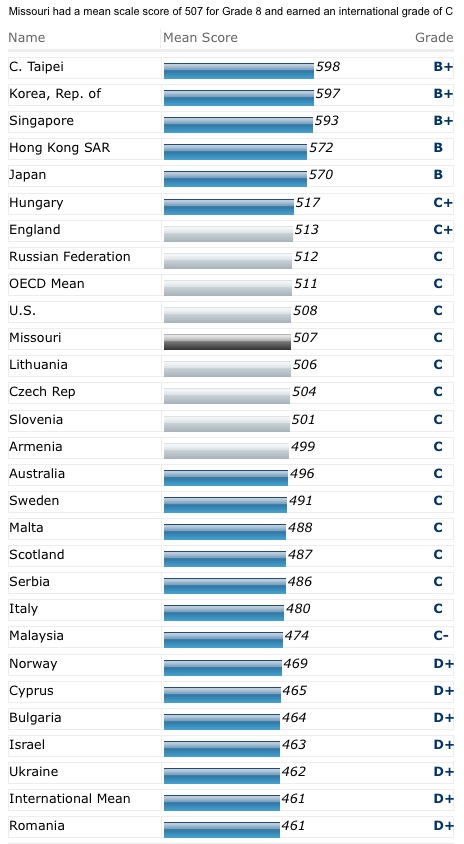
Missouri beats Lithuania by one—in math

photo by apesara
Last fall, I blogged about the importance of comparing our students not just to other students locally or to other states but internationally. Ideally, we would have information for individual districts, but until we do, the American Institutes for Research has released a report that allows you to compare individual states with other countries. Missouri, not surprisingly, is right at the U.S. median for both fourth and eighth grade math scores.
At the fourth grade level only six states received a B; by eighth grade only Massachusetts received a B.
“These Asian nations consistently perform at the B+, B, and B- levels,” Phillips [acting commissioner of the National Center for Education Statistics from 1999 to 2002] said. “Their students are learning mathematics not just at a higher level than students in the United States, but at a level that is a quantum leap higher.” The math proficiency average for U.S. students is C+ in grade 4 and C at grade 8. (AIR news release 16 June 2009)
Since Missouri is right behind the U.S. average, we are not competing well against Asian students.
“Our states and school districts should no longer be comparing themselves to their neighbors. They will be competing for jobs and innovations with students around the globe.” (AIR news release 16 June 2009)
I’ve said that before.
our states and school districts fall comparatively further behind in Grade 8 than they do in Grade 4. Although the United States falls further behind in the higher grade, the highest achieving countries maintain their level of performance. AIRInternationalBenchmarks2009
The middle school problem is real in the United States and, apparently, Missouri also. As a culture we are more concerned about their social lives than their academic abilities. Our expectations are not high-- “They can’t think clearly with all those hormones!” --but they obviously work hard in other countries. I would love to see if any of our middle schools are bucking this trend.
Here is the chart showing where Missouri places compared to other countries for eighth grade math. The grey bars are for countries with scores that are considered statistically similar. The interactive chart is fascinating to play with. I eagerly await the time when we can put individual school districts in for comparison.
Missouri top schools in math

Photo by Fábio Pinheiro
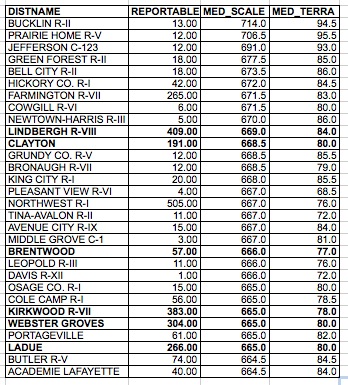
As part of my mission to widen the focus from St. Louis area to at least the state, I looked at the top school districts in Missouri in math in fourth grade and tenth grade. I chose fourth grade to give students the first year of testing to get used to taking standardized exams. I chose tenth grade as the highest grade of testing to look at the overall or “final” results of the district’s teaching. I looked at the median scale score instead of the number of proficient and advanced as I felt it was more representative of the spectrum of abilities including the advanced students. Also, this would discourage districts from overfocusing on the “bubble” students and, instead, work with each one equally. The median is more representative than mean as it is less affected by a student who fills in bubbles in cute patterns or one or two 0 scores. Many of the top school districts have grade levels that are quite small, so I included the numbers for perspective. I also included the median Terra Nova score to provide some national comparison and a frame of reference for the MAP scale score.
Missouri top 30 school districts 4th grade math
Missouri top 40 school districts 10th grade math
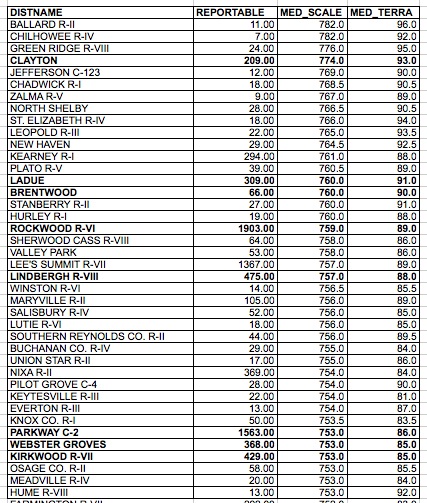
I dipped down to the top 40 (41) instead of the top 30 for the 10th grade math to pick up three more St. Louis County school districts.
To me it’s clear that while St. Louis County schools are strong, they have some competition in the state that should be acknowledged.
Moving beyond the math wars
I'm agnostic on the math wars—I see the arguments to both sides. Traditional curricula don't do enough to teach the why's of math, but the reform lacks rigor on the how's. So I'm excited to see my favorite curriculum make its way to the St. Louis metro area public schools.
❝Wentzville is believed to be the first public school district in the St. Louis area to plan a widespread adoption of Singapore math, said Jeffery Thomas, president of SingaporeMath.com, which supplies school districts and home schoolers with books for the program. Some other districts in the region have recently purchased review materials, he said. The program or something similar already is taught in some private schools in St. Louis, and about 800 schools nationwide.❞
Singapore is rigorous with an inspired visual method of teaching problem solving that leads kids into algebra using bar diagrams. Even those who use a different curriculum could supplement with its Challenging Word Problems books. But this doesn't come at the expense of students who need more help like one of the private schools that have already started using Singapore.
❝City Academy, the private school on North Kingshighway that targets disadvantaged students, introduced the program this year. It is already reaping the benefits of the switch from the way math is traditionally taught in the United States.❞
The U.S. distributor recently revamped the series to match California standards, which should make it easier for public schools to adopt it because the scope and sequence should line up better with standardized tests.
Singapore may use the traditional algorithms, but it still isn't like a traditional math program.
❝William Tate, professor and chairman of the department of education at Washington University, said that a series of workshops for parents consistent with what the teachers learned about the Singapore math would be vital. The program is different enough from traditional teaching that parents will have a steep learning curve, he said.❞
Now that parents are finally figuring out reform math, but the effort is well worth it.
Teachers can do research too!
The St. Louis Post profiled an elementary teacher in the beleaguered city school system.
❝Johnson labored at night and through winter and summer breaks for three years, and the product of that passion is a supplemental learning project. It represents one teacher's homegrown effort to solve one classroom's deficiencies, with the hope of later helping to turn around an entire district.❞
The program works by having students progress through levels as they learn their basic math facts down cold.
❝When a master steps to the podium, there's good reason that mesmerized classmates congregate at the podium like mere mortals gathering at the cage while Albert Pujols takes batting practice:
A master can write the answers to 100 multiplication questions in 110 seconds.❞
It sounds like a personalized version of the Fastt Math that is becoming popular in suburban districts.
I want to highlight one of the problems with the attitude of the city school district.
❝Though district officials subscribe to the theory that the achievement gap needs to be erased one classroom at a time, they say educational practices must first undergo rigorous research and academic review.
"He knows what works for him. That's not to say he doesn't have a program that works well for his students. But he doesn't have the research base yet to implement what he is doing on a larger scale," said William Parker, an assistant superintendent for elementary education.❞
I understand wanting to use research-based curriculum changes, but the district is essentially telling its teachers that no matter how hard they work and how effective they are since they can't provide the large research basis that commercial suppliers can, they are not as important. A better response would be to work with him to run a larger pilot study and to help publish. Working with teachers as collaborators instead of just implementers of off-the-shelf but "researched" curriculum would go a long way toward improving working conditions.
❝When his wife, Cathy, asks why Johnson remains in the city when he "could be making $10,000 more to work in the county" his response is uniform. And it starts with those students who hail, as he did, from a single-parent home absent a father.❞
While the city schools don't pay that much less than the county, an effective African-American male elementary teacher is highly recruitable. The city shouldn't rely on his desire to help kids from single-parent homes and should provide the supportive environment that teachers like him need, including helping them know how to share their work with others.
Barbie likes math!

Since I have a daughter interested in math, I've been closely following the girls in math topic for awhile. I was ecstatic to hear how well the girls' math olympiad team did in China. More importantly, they had fun. Ira Flatow, of NPR's Talk of the Nation: Science Friday, interviewed the coach and one of the team members in a segment on Women, Girls and Math. In an interesting "comment," Flatow asked the girl if team had been invited to the White House like so many winning sports teams. I think our country's priorities were demonstrated by her answer.